Nature, Published online: 08 July 2025; doi:10.1038/d41586-025-02053-4
Women with a rare type of ovarian cancer have prolonged survival after receiving immune-checkpoint blockade if their tumour cells carry a mutation in the gene PPP2R1A.
Nature, Published online: 08 July 2025; doi:10.1038/d41586-025-02053-4
Women with a rare type of ovarian cancer have prolonged survival after receiving immune-checkpoint blockade if their tumour cells carry a mutation in the gene PPP2R1A.
Nature, Published online: 08 July 2025; doi:10.1038/d41586-025-02065-0
Researchers studying research must avoid the temptation to get too stuck in the academic weeds.

A new study addresses the growing global crisis of antibiotic-resistant infections.
Many of these drug-resistant bacteria are spread through hospitals, and there are few antibiotics available for treatment.
The study in Proceedings of the National Academy of Sciences (PNAS) looks at a particular bacterium called Acinetobacter baumannii, which is highly infectious, spread mostly in hospitals, and typically infects immunocompromised patients.
The researchers employed an entirely new strategy to identify weaknesses specific to resistant bacteria and then target these weaknesses with an alternate drug.
They found that fendiline, a drug that acts as a calcium channel blocker and formerly used to treat heart arrhythmia, kills the bacterium by targeting the essential lipoprotein trafficking pathway, which is weakened in antibiotic resistant bacteria.
“It’s critical that we find more and better therapeutics that can target these antibiotic-resistant infections which affect patients on ventilators, those with deep soft tissue infections, and the immunocompromised,” says Philip Rather, corresponding author on the paper and professor in the Emory University School of Medicine.
“This novel finding repurposes an existing drug, exploits a newly identified vulnerability in an antibiotic-resistant bacterium, and opens doors for developing new antibiotics targeting similar pathways,” says Jennifer Colquhoun, first author and research scientist at Emory.
Source: Emory University
The post Heart drug kills dangerous antibiotic resistant bacteria appeared first on Futurity.

A new study is shedding light on why solar radiation is more effective than other forms of energy at causing water to evaporate.
The key factor turns out to be the oscillating electric field inherent to sunlight itself.
“This work substantially advances our understanding of what’s taking place in this phenomenon…”
“It’s well established that the sun is exceptionally good at causing water to evaporate—more efficient than heating water on the stove, for instance,” says Saqlain Raza, first author of a paper on the work and a PhD student at North Carolina State University.
“However, it has not been clear exactly why. Our work highlights the role that electric fields play in this process.”
“This is part of a larger effort in the research community to understand this phenomenon, which has applications such as engineering more efficient water-evaporation technologies,” says Jun Liu, co-corresponding author of the paper and an associate professor of mechanical and aerospace engineering at NC State.
To explore questions related to sunlight’s efficiency at evaporating water, the researchers turned to computational simulations. This allowed them to alter different parameters associated with sunlight to see how those characteristics influence evaporation.
“Light is an electromagnetic wave, which consists—in part—of an oscillating electric field,” Liu says.
“We found that if we removed the oscillating electric field from the equation, it takes longer for sunlight to evaporate water. But when the field is present, water evaporates very quickly. And the stronger the electric field, the faster the water evaporates. The presence of this electric field is what separates light from heat when it comes to evaporating water.”
But what exactly is the oscillating electric field doing?
“During evaporation, one of two things is happening,” Raza says. “Evaporation either frees individual water molecules, which drift away from the bulk of liquid water, or it frees water clusters.
“Water clusters are finite groups of water molecules which are connected to each other but can be broken away from the rest of the liquid water even though they are still interconnected. Usually both of these things happen to varying degrees.”
“We found that the oscillating electric field is particularly good at breaking off water clusters,” says Liu.
“This is more efficient, because it doesn’t take more energy to break off a water cluster (with lots of molecules) than it does to break off a single molecule.”
The researchers demonstrated this by simulating how evaporation works in a model of pure water and how evaporation works in a model where water saturates a hydrogel.
“In pure water, you don’t find many water clusters near the surface—where evaporation can take place,” says Raza.
“But there are lots of water clusters in the second model, because they form where the water comes into contact with the hydrogel. Because there are more water clusters near the surface in the second model, evaporation happens more quickly. Basically, there are more water clusters that the oscillating field can cleave off from the liquid water.”
“This work substantially advances our understanding of what’s taking place in this phenomenon, since we are the first to show the role of the water clusters via computational simulation,” says Liu.
The paper appears in the journal Materials Horizons.
Additional coauthors are from NC State and the Huazhong University of Science and Technology.
Support for this work came from the American Chemical Society’s Petroleum Research Fund.
Source: North Carolina State University
The post Why is the sun so good at evaporating water? appeared first on Futurity.
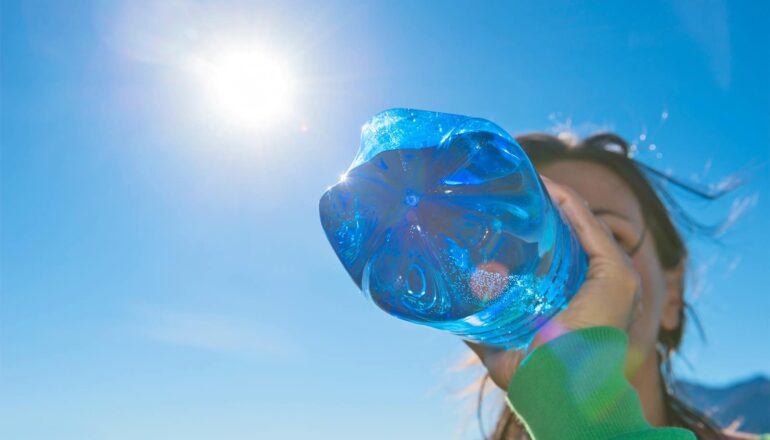
Nutrition experts have answers for you about potential advantages to consuming alkaline water, electrolyte water, or other enhanced H20.
It’s hot and you’re thirsty, so you pop into a store to up your hydration levels. In the water aisle and in the coolers, you’re confronted with a plethora of labels boasting benefits from specific types of water, like alkaline water, electrolyte water, enhanced water, and even flavored water.
But is there a nutritional advantage to picking up one versus another?
Roger Fielding, senior scientist at the Jean Mayer USDA Human Nutrition Research Center on Aging (HNRCA) and professor of biochemical and molecular nutrition at Tufts University, says the short answer is simple: “no.”
“There’s no physiological basis that there’s some metabolic benefit to these specialty waters over just regular, plain old water,” Fielding says.
Since most people tend not to consume enough liquids and lean more toward a dehydrated state, Fielding’s advice is simply to drink more fluids.
“If you have a preference for a beverage and that’s going to make you drink more and you’ll be more attentive to rehydrating with that beverage, and you have the resources to purchase that beverage, well, have at it,” Fielding says.
“Just like with sweetened beverages to an extent, if you’re not in excess, you’re more likely to rehydrate because a beverage is sweetened or flavored.”
That doesn’t mean we should ignore nutrition labels, though. Paying specific attention to sodium levels in beverages—even in water—is important. Adults should aim to consume less than 2 grams of sodium per day and some waters, like those labeled as having electrolytes, may contain elevated levels of sodium due to the addition of sodium potassium and, in some cases, salt itself.
“If someone consumes large amounts of water with high levels of sodium, they could elevate their risk of hypertension and other negative cardiovascular outcomes associated with excess salt intake,” Fielding says. “But most of these beverages that provide those kinds of electrolytes, they’re fairly dilute.”
Fielding says even for endurance athletes and people who may exercise in environments like heated yoga studios, it’s “very difficult to induce an electrolyte deficiency,” and consuming electrolyte-enhanced water will not make much difference in changing the electrolyte concentration in our bodies.
Electrolytes, which play a vital role in helping our bodies regulate chemical reactions, are both produced in our bodies in the form of bicarbonate and are consumed through food and drinks in the forms of sodium and potassium chloride.
“The electrolyte concentrations inside our cells, and also in the fluids that are outside our cells, like the blood for example, are very tightly controlled and regulated,” Fielding says.
“That’s because they have an impact on how our muscles function, how our kidneys work, and how our hearts sort of beat 72 times every minute. So, increasing the electrolyte concentrations by consuming a beverage is not going to influence the overall electrolyte concentrations in our bodies.”
Bess Dawson-Hughes, a senior scientist at the HNRCA, professor of medicine at Tufts University School of Medicine, and an endocrinologist, believes young consumers would likely find no benefit in picking up a bottle labeled as alkaline water.
“We don’t have direct evidence that shows a benefit from alkaline water interventions compared with non-alkaline water interventions,” Dawson-Hughes says.
“But it would be logical if, as an older person, you have an acid-producing diet and it’s costing you bone and muscle that you might do well to get alkali any way you could get it.”
American diets tend to be high in foods like proteins and grains, and the sulfur in these foods is metabolized into acid by the kidneys, Dawson-Hughes explains. For that reason, it’s imperative that we eat enough fruits and vegetables—or alkali foods—to help our bodies achieve pH balance.
“When we’re young, our kidneys are functional enough to make needed adjustments to get us pH balanced, by dumping extra hydrogen ions,” Dawson-Hughes says.
“When we age, our kidneys decline in that capacity. If the kidney can’t get rid of excess acid, guess what happens next? Bone is resorbed or lost because bone is, in essence, an alkali reservoir.”
Fielding, who also studies aging populations, could see why enhanced waters would benefit someone who has trouble remembering to drink fluids or avoids drinking fluids due to issues with incontinence or another urinary dysfunction.
“For caregivers and providers, it’s important to remind the aging population that staying hydrated is important,” Fielding says. “We need to encourage people to consume an adequate amount of liquid, because they might not know to do it on their own.”
But the bottom line, whether it is for someone in their 80s, someone who exercises regularly, or finds themselves sitting at a desk for work, is to replenish with plain old H20.
“The best fluid replacement that you can probably drink to prevent becoming dehydrated is water,” Fielding says. “Water trumps everything, except in maybe some very extreme circumstances.”
Source: Tufts University
The post Is 1 type of water healthier for you than others? appeared first on Futurity.
Canadian company NordSpace hopes to be the first in the country’s history to launch an orbital rocket from Canadian soil. They’ve got the support of ProtoSpace, a specialized aerospace manufacturing provider hoping to support Canada’s budding space industry.
The Sony A7 III is $1380 from Walmart on this anti-Prime deal and is a huge $118 cheaper than Amazon!
We’ve rounded up the best Amazon Prime Day drone deals as the retailer’s annual sales event kicks off on July 8 and runs through to July 11.
Nature, Published online: 08 July 2025; doi:10.1038/d41586-025-02066-z
Better stress assessment and tailored interventions could give clinicians the tools they need to fend off lasting damage.
Nature, Published online: 08 July 2025; doi:10.1038/d41586-025-02063-2
Severe blows to the ‘deaf-scientist pipeline’ must not mean abandoning its best practices. Here is how to support current and future students.