
Category: 未分类

  • Why is the sun so good at evaporating water?

    The sun sets over a body of water.

    A new study is shedding light on why solar radiation is more effective than other forms of energy at causing water to evaporate.

    The key factor turns out to be the oscillating electric field inherent to sunlight itself.

    “This work substantially advances our understanding of what’s taking place in this phenomenon…”

    “It’s well established that the sun is exceptionally good at causing water to evaporate—more efficient than heating water on the stove, for instance,” says Saqlain Raza, first author of a paper on the work and a PhD student at North Carolina State University.

    “However, it has not been clear exactly why. Our work highlights the role that electric fields play in this process.”

    “This is part of a larger effort in the research community to understand this phenomenon, which has applications such as engineering more efficient water-evaporation technologies,” says Jun Liu, co-corresponding author of the paper and an associate professor of mechanical and aerospace engineering at NC State.

    To explore questions related to sunlight’s efficiency at evaporating water, the researchers turned to computational simulations. This allowed them to alter different parameters associated with sunlight to see how those characteristics influence evaporation.

    “Light is an electromagnetic wave, which consists—in part—of an oscillating electric field,” Liu says.

    “We found that if we removed the oscillating electric field from the equation, it takes longer for sunlight to evaporate water. But when the field is present, water evaporates very quickly. And the stronger the electric field, the faster the water evaporates. The presence of this electric field is what separates light from heat when it comes to evaporating water.”

    But what exactly is the oscillating electric field doing?

    “During evaporation, one of two things is happening,” Raza says. “Evaporation either frees individual water molecules, which drift away from the bulk of liquid water, or it frees water clusters.

    “Water clusters are finite groups of water molecules which are connected to each other but can be broken away from the rest of the liquid water even though they are still interconnected. Usually both of these things happen to varying degrees.”

    “We found that the oscillating electric field is particularly good at breaking off water clusters,” says Liu.

    “This is more efficient, because it doesn’t take more energy to break off a water cluster (with lots of molecules) than it does to break off a single molecule.”

    The researchers demonstrated this by simulating how evaporation works in a model of pure water and how evaporation works in a model where water saturates a hydrogel.

    “In pure water, you don’t find many water clusters near the surface—where evaporation can take place,” says Raza.

    “But there are lots of water clusters in the second model, because they form where the water comes into contact with the hydrogel. Because there are more water clusters near the surface in the second model, evaporation happens more quickly. Basically, there are more water clusters that the oscillating field can cleave off from the liquid water.”

    “This work substantially advances our understanding of what’s taking place in this phenomenon, since we are the first to show the role of the water clusters via computational simulation,” says Liu.

    The paper appears in the journal Materials Horizons.

    Additional coauthors are from NC State and the Huazhong University of Science and Technology.

    Support for this work came from the American Chemical Society’s Petroleum Research Fund.

    Source: North Carolina State University

    The post Why is the sun so good at evaporating water? appeared first on Futurity.
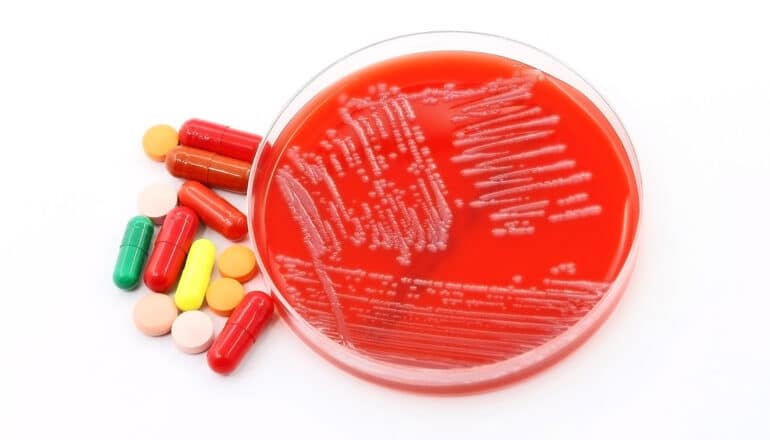
  • Heart drug kills dangerous antibiotic resistant bacteria

    A petri dish filled with Acinetobacter baumannii bacteria sits next to a pile of colorful pills.

    A new study addresses the growing global crisis of antibiotic-resistant infections.

    Many of these drug-resistant bacteria are spread through hospitals, and there are few antibiotics available for treatment.

    The study in Proceedings of the National Academy of Sciences (PNAS) looks at a particular bacterium called Acinetobacter baumannii, which is highly infectious, spread mostly in hospitals, and typically infects immunocompromised patients.

    The researchers employed an entirely new strategy to identify weaknesses specific to resistant bacteria and then target these weaknesses with an alternate drug.

    They found that fendiline, a drug that acts as a calcium channel blocker and formerly used to treat heart arrhythmia, kills the bacterium by targeting the essential lipoprotein trafficking pathway, which is weakened in antibiotic resistant bacteria.

    What the researchers say

    “It’s critical that we find more and better therapeutics that can target these antibiotic-resistant infections which affect patients on ventilators, those with deep soft tissue infections, and the immunocompromised,” says Philip Rather, corresponding author on the paper and professor in the Emory University School of Medicine.

    “This novel finding repurposes an existing drug, exploits a newly identified vulnerability in an antibiotic-resistant bacterium, and opens doors for developing new antibiotics targeting similar pathways,” says Jennifer Colquhoun, first author and research scientist at Emory.

    Why it matters

    • The discovery that fendiline can selectively kill drug-resistant bacteria suggests a fast-track potential for treating infections that are currently difficult or impossible to manage with existing antibiotics.
    • Since fendiline is already FDA-approved, there is potential for quicker clinical trials and deployment in treating serious hospital-acquired infections, particularly in immunocompromised patients.
    • The drug selectively targets the specific bacterium, leaving the healthy bacteria in a patients gut flora intact.

    Source: Emory University

    The post Heart drug kills dangerous antibiotic resistant bacteria appeared first on Futurity.

  • Metascience can improve science — but it must be useful to society, too

    Nature, Published online: 08 July 2025; doi:10.1038/d41586-025-02065-0

    Researchers studying research must avoid the temptation to get too stuck in the academic weeds.

  • Genetic mutation predicts survival after immunotherapy for ovarian cancer

    Nature, Published online: 08 July 2025; doi:10.1038/d41586-025-02053-4

    Women with a rare type of ovarian cancer have prolonged survival after receiving immune-checkpoint blockade if their tumour cells carry a mutation in the gene PPP2R1A.

  • Inventions that made the United States a powerhouse of innovation

    Nature, Published online: 08 July 2025; doi:10.1038/d41586-025-02061-4

    Lessons learnt from early lunar research, and the birthplace of ‘pictures that live and move’, in our weekly peek at Nature’s archive.

  • Why these zombie caterpillars can’t stop eating 

    Sneaky chemistry by a real-life “Last of Us” Cordyceps fungus mind controls its zombie insect victims by convincing them they’re starving.

  • Scientists 3-D printed a tiny elephant inside a cell

    The first structures ever 3-D printed inside living cells point to applications for biology research.

  • Cutting-Edge Physics and Chemistry Now Unfold One Attosecond at a Time

    An attosecond—or 0.000000000000000001 second—is no time at all for a person. That is not so for electrons, atoms and molecules, and laser-wielding scientists are revealing the action

  • Why Texas' 'Flash Flood Alley' Is So Deadly, Explained by Geology

    A hydrologist explains why Texas Hill Country is known as Flash Flood Alley and how its geography and geology can lead to heavy downpours and sudden, destructive floods

  • What time is the full moon on July 10?

    Find out what time the full moon rises on July 10, 2025, how to see the Buck Moon from your location, and why it looks bigger near the horizon.