The “Bell test” was devised in the 1960s to uncover what’s going on in the quantum world, but it continues to be relevant today, says Karmela Padavic-Callaghan
Briefing
-
Metabolic adaptations direct cell fate during tissue regeneration
Nature, Published online: 11 June 2025; doi:10.1038/s41586-025-09097-6
Metabolic enzymes of the tricarboxylic acid cycle, such as 2-oxoglutarate dehydrogenase, are differentially expressed in absorptive and secretory lineages, guiding cell fate establishment and offering insights for targeted regenerative therapies.
-
Who is on RFK Jr’s new vaccine panel — and what will they do?
Nature, Published online: 12 June 2025; doi:10.1038/d41586-025-01852-z
Critics fear that anti-vaccine leader’s picks for crucial committee will be a ‘disaster for public health’.
-
Is the plastic in your kitchen dangerous for your health?

Plastic containers and utensils are staples in many kitchens—but could they be affecting your health?
Plastics, often seen as a single material, are actually made from many different polymers, each with a unique chemical makeup. They contain different chemical additives like dyes, plasticizers, and flame retardants. As these plastics interact with microbes and environmental chemicals, the risk to human health becomes more complex.
One of the most common ways people are exposed to plastics is in the kitchen:
- Black plastic spatulas and other utensils may contain harmful chemicals picked up when recycled from electronic waste.
- Plastic cutting boards shed tiny fragments of varying shapes and sizes that can be ingested.
- Plastic containers can leach chemicals when heated in the microwave.
- Plastic food containers
Black plastic & your health
Black plastic is commonly used in kitchen utensils, takeout containers, food trays, and children’s toys. But many of these products are made from recycled electronic waste, which can contain harmful chemicals like brominated flame retardants and heavy metals. These chemicals have been linked to a variety of health concerns, including:
- cancer
- endocrine disruption
- neurotoxicity
- infertility
A recent study found flame retardants in 85% of 203 tested consumer products, including banned chemicals, suggesting they were made from old electronic waste.
Are plastics a risk for kids?
Children are more vulnerable to environmental chemicals because their bodies and brains are still developing.
“Flame retardants have been detected in breast milk samples across the US. Children can also be exposed through contaminated food and house dust,” says Jane van Dis, assistant professor of obstetrics and gynecology at University of Rochester Medical Center.
Some plastic toys contain flame retardants that may leach out when children chew on them, exposing children to chemicals that can affect brain and reproductive system development.
Plastic cutting boards
A recent study tried to mimic everyday exposure by feeding mice microplastics made by chopping on real plastic cutting boards. The results showed that different plastics caused different health effects: one type led to gut inflammation, while another changed the gut bacteria. This suggests that real-life plastic exposure is more complicated than lab studies conducted on single types of standard particles might suggest.
In an invited commentary on the study, the co-directors of the Lake Ontario MicroPlastics Center (LOMP), Katrina Korfmacher, professor of environmental medicine at the University of Rochester Medical Center, and Christy Tyler, professor at RIT, reflected on how much plastic we might be adding to our food just by preparing meals at home using plastic tools and containers.
They emphasize that while microplastic exposure is a growing concern, we still don’t fully understand how it affects human health. For instance, although lab studies link microplastics to gut inflammation, only a small percentage of people have such symptoms.
How can you limit exposure?
“The ways that flame retardants and other harmful chemicals end up in plastics we use on a daily basis are complex, as are the solutions,” says Korfmacher.
Still, there are simple ways to reduce exposure:
- Choose wood or stainless steel utensils over black plastic.
- Avoid microwaving food in plastic containers.
- Wash hands and wipe down surfaces after handling plastic packaging.
- Don’t let young children chew on plastic toys.
“These substances are known endocrine disruptors, meaning they can interfere with hormonal systems and potentially lead to various health issues,” says van Dis.
In the long run, they argue that better testing, safer alternatives, and preventing electronic waste from entering the production of consumer products—especially those that come in contact with food—need to occur to reduce sources of exposure.
Source: University of Rochester
The post Is the plastic in your kitchen dangerous for your health? appeared first on Futurity.
-
‘Magic’ lenses make infrared light visible

Researchers have developed an ultra-thin lense that can transform infrared light into visible light.
Lenses are the most widely used optical devices. Camera lens or objectives, for example, produce a sharp photo or video by directing light at a focal point.
The speed of evolution made in the field of optics in recent decades is exemplified by the transformation of conventional bulky cameras into today’s compact smartphone cameras.
Even high-performance smartphone cameras still require a stack of lenses that often account for the thickest part of the phone. This size constraint is an inherent feature of classic lens design—a thick lens is crucial for bending light to capture a sharp image on the camera sensor.
Major strides in the field of optics over the past ten years have sought to overcome this limitation and have come up with a solution in the form of metalenses. They are flat, perform in the same way as normal lenses, and are not only 40 times thinner than an average human hair but also lightweight as they do not need to be made of glass.
A special metasurface composed of structures a mere hundred nanometers in width and height (one nanometer is one billionth of a meter) modifies the direction of light. Using such nanostructures researchers can radically reduce the size of a lens and make it more compact.
When combined with special materials, these nanostructures can be used to explore other unusual properties of light. One example is nonlinear optics, where light is converted from one color into another. A green laser pen works according to this principle: infrared light goes through a high-quality crystalline material and generates light of half the wavelength—in this case green light. One well-known material that produces such effects is lithium niobate. This is used in the telecommunications industry to create components that interface electronics with optical fibres.
Rachel Grange, a professor at the Institute for Quantum Electronics at ETH Zurich, conducts research into the fabrication of nanostructures with such materials. She and her team have developed a new process that allows lithium niobate to be used to create metalenses. The study appears in the journal Advanced Materials.
For her new method, the physicist combines chemical synthesis with precision nanoengineering.
“The solution containing the precursors for lithium niobate crystals can be stamped while still in a liquid state. It works in a similar way to Gutenberg’s printing press,” co-first author Ülle-Linda Talts, a doctoral student working with Grange, explains. Once the material is heated to 600°C (1112°F), it takes on crystalline properties that enable the conversion of light as in the case of the green laser pen.
The process has several advantages. Producing lithium niobate nanostructures is difficult using conventional methods as it is exceptionally stable and hard. According to the researchers, this technique is suitable for mass production as an inverse mould can be used multiple times, allowing the printing of as many metalenses as needed. It is also much more cost-effective and faster to fabricate than other lithium niobate miniaturized optical devices.
Using this technique, the researchers in Grange’s group succeeded in creating the first lithium niobate metalenses with precisely engineered nanostructures. While functioning as normal light focusing lenses, these devices can simultaneously change the wavelength of laser light. When infrared light with a wavelength of 800 nanometers is sent through the metalens, visible radiation with a wavelength of 400 nanometers emerges on the other side and is directed at a designated point.
This magic of light conversion, as Grange calls it, is only made possible by the special structure of the ultra-thin metalens and its composition of a material that allows the occurrence of what is known as the nonlinear optical effect. This effect is not limited to a defined laser wavelength, making the process highly versatile in a broad range of applications.
Metalenses and similar hologram-generating nanostructures could be used as security features to render banknotes and securities counterfeit-proof and to guarantee the authenticity of artworks. Their exact structures are too small to be seen using visible light, while their nonlinear material properties allow highly reliable authentication.
Researchers can also use simple camera detectors to convert and steer the emission of laser light to make infrared light—in sensors, for example—visible. Or for reducing the equipment needed for deep-UV light patterning in state-of-the-art electronics fabrication.
The field of such ultra-thin optical elements—known as metasurfaces—is a relatively young branch of research at the interface between physics, materials science and chemistry.
“We have only scratched the surface so far and are very excited to see how much of an impact this type of new cost-effective technology will have in the future,” emphasizes Grange.
The study was funded in part by an SNFS Consolidator Grant to Rachel Grange.
Source: ETH Zurich
The post ‘Magic’ lenses make infrared light visible appeared first on Futurity.
-
Tiny changes in the heart may cut irregular heartbeat risk
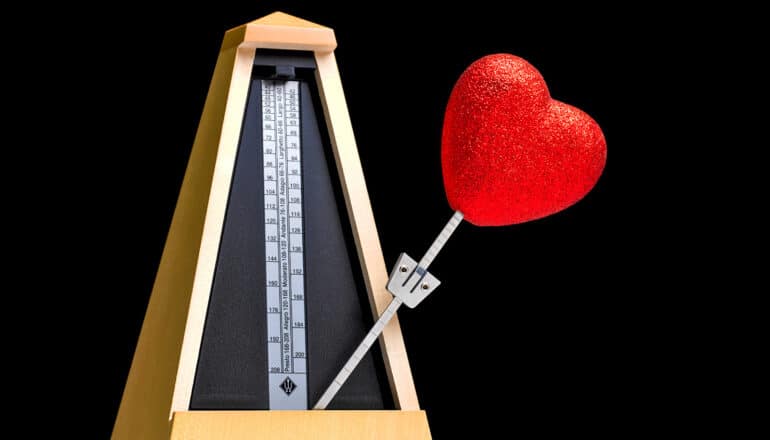
Researchers have found that microscopic structural changes in heart cells may help reduce arrhythmia risk.
Medically known as arrhythmias, irregular heartbeats become more common with age and can lead to health problems.
But a new study in JACC Clinical Electrophysiology, a journal of the American College of Cardiology, reveals that a tiny gap between heart cells called the perinexus naturally narrows with age—an adaptation that may help stabilize heart rhythm.
The discovery challenges the idea that all age-related changes in the heart are harmful.
“As we get older and cardiac cells get bigger, the body compensates by making electrical communications more robust,” says Steven Poelzing, a professor at the Fralin Biomedical Research Institute at Virginia Tech .
“Making sure the communication between cells remains high during aging appears to occur naturally to keep cardiovascular disease in check.”
Poelzing suggests that the body compensates for an aging heart by reinforcing the structure between cells to strengthen electrical communication and support the rapid influx of sodium ions that initiate each heartbeat.
Arrhythmias occur when the heart’s electrical signals become too fast, too slow, or disorganized. They affect millions worldwide and can range from harmless to life-threatening, increasing the risk of stroke, heart failure, and sudden cardiac arrest.
The National Heart, Lung, and Blood Institute reports that atrial fibrillation is the most common arrhythmia, affecting more than 2 million adults in the United States, with numbers expected to rise significantly.
To investigate how structural changes in the heart impact arrhythmia risk, researchers studied young and old guinea pig hearts, using medication to trigger a condition called sodium channel gain of function.
They found that older hearts naturally had a narrower perinexus, which appeared to protect against arrhythmias. However, when this space was artificially widened, older hearts quickly developed irregular rhythms, while younger hearts remained stable.
As heart cells grow larger with age, they adhere more tightly, maintaining electrical stability.
“If you can keep cells nicely packed, you can conceal a lot of age-associated cardiac pathologies,” says Poelzing, who is also a professor in the biomedical engineering and mechanics department in the Virginia Tech College of Engineering.
He compared it with a house’s foundation: If the foundation is solid, the structure can tolerate wear and tear elsewhere. But if the foundation is unstable, the whole structure is at greater risk.
From a clinical perspective, Poelzing says this study also sheds light on why arrhythmias can be difficult to detect in aging patients.
Cardiologists refer to some heart diseases as “concealed” because the body naturally compensates for electrical instability—returning to normal function before a problem can be caught on standard tests. This is why doctors often rely on long-term monitoring to detect arrhythmias before the heart re-stabilizes the issue.
An accompanying editorial in JACC: Clinical Electrophysiology comments on the study, describing the delicate, “push-and-pull” balance between the perinexus size and electrical activity in the heart. The editorial also highlights the broader significance of the findings, suggesting that targeting perinexus size could offer new strategies for preventing arrhythmias and improving heart health as people age.
Additional researchers from Virginia Tech and Ohio State University contributed to the work.
The research was supported by National Heart, Lung, and Blood Institute of the National Institutes of Health.
Source: Virginia Tech
The post Tiny changes in the heart may cut irregular heartbeat risk appeared first on Futurity.
-
June full moon shines on SpaceX Dragon | Space photo of the day for June 12, 2025
SpaceX’s private Dragon spacecraft was treated to a stunning view in the night sky under June’s full moon.
-
Satellite images show a dramatic decline in Antarctica's emperor penguin population — and it's happening faster than we thought (photos)
One region of the continent saw a 22% decline in emperor penguin numbers over 15 years.
-
Aurora alert! Moderate geomagnetic storm could spark northern lights as far south as New York and Idaho on June 14
Aurora chasers, keep your eyes on the skies this weekend as northern lights might be possible at mid-latitudes.
-
An entrepreneur wants to build a giant net to catch spacecraft landing on the moon, but can it be done?
This novel idea could become an important piece of a future moon economy.