Briefing

  • Rising Concerns of Climate Extremes and Land Subsidence Impacts

    Photo of a large crater
    Editors’ Vox is a blog from AGU’s Publications Department.

    A recent article in Reviews of Geophysics explores land subsidence drivers, rates, and impacts across the globe. It also discusses the need for improved process representations and the inclusion of the interplay among land subsidence and climatic extremes, including their effects in models and risk assessments. Here, we asked the lead author to explain the concept of land subsidence, its impacts, and future directions needed for improved mitigation.

    What is land subsidence? 

    Land subsidence (LS) refers to the relative sinking or lowering of the Earth’s land surface. LS is a pressing global issue that warrants action since subsidence can adversely impact infrastructure, humans, and the environment across various landscapes and climates (Figure 1). It may be driven by one or more natural processes and/or human activities that compound to cause localized or expansive ground deformation. Differential LS causes structures and roadways to crack and buckle. LS can also reduce the water storage capacity of aquifers. Notably, LS can be recoverable (e.g., natural variations in groundwater levels) or permanent (e.g., overdraft causing irreversible compaction).  

    Figure 1. Reported LS rates and drivers around the world based on literature. (a) Map of primary LS drivers (colors) indicating mean (circles) and maximum (triangles) rates (shape sizes). A shared color scheme (shown in (b)) demarcates the main causes of LS in (a) and (b). (b) 50 largest mean LS rates for global locations (numbered along x-axis and listed above). LS rates are often nonlinear, temporally dependent, and occur at various time scales. Rates shown were not all observed or estimated over the same time period. Credit: Huning et al. [2024], Figure 1.

    Why is it important to understand and monitor land subsidence? 

    Various LS drivers and physical processes exist and interact with one another (Figure 1). LS is often closely related to natural resources demand, which increases with growing urbanization and megacities. The proximity of LS to critical infrastructure like water conveyance, transportation, and utility systems is a significant concern since LS could cause catastrophic lifeline failures, outages, and/or loss of life. Also, feedbacks between climatic extremes (e.g., droughts, floods, wildfires, heatwaves) and LS impacts exist, but are not fully understood.

    Although a chronic hazard, LS may initially go unnoticed as sinking typically occurs slowly. This influences perceived risk and contributes to reactive policies, regulations, and mitigation steps targeting LS and its implications rather than proactive measures. Furthermore, the compounding effects of extreme events and their impacts can exacerbate LS. More pronounced interactions are likely with projected rises in climate extremes.

    How do scientists monitor and measure land subsidence across the globe? 

    Scientists use various techniques and technologies to measure LS, including ground-based surveys, subsurface instrumentation, and satellite-based observations. Satellite-based Synthetic Aperture Radar (SAR) has revolutionized LS monitoring and mapping. It is an active remote sensing system that emits microwave pulses and receives echoes. Such systems can operate under various conditions (e.g., day and night, in cloudy skies) and produce high-resolution imagery. With SAR-based information, scientists can infer surface deformation by computing phase differences between SAR snapshots over a region using techniques like interferometric SAR (InSAR). SAR-based observations commonly inform impact assessments for agriculture, structural health, and resource management.

    What are the major natural and anthropogenic drivers of land subsidence? 

    Naturally-occurring processes and human activities can independently drive LS or enhance existing LS rates (Figure 2). Some examples of natural drivers of LS include: natural consolidation, volcanic or tectonic activity, seasonal groundwater level variations, and soil organic material decomposition. Extraction of natural resources (e.g., fossil fuels, groundwater), removal of wetlands and peatlands, and loading from rapid urbanization serve as examples of human-related activities contributing to LS. Natural resource extraction is a leading anthropogenic driver of LS (Figure 1), which often rises with increasing population. Also, extreme events such as wildfires or heatwaves can trigger LS in permafrost areas by thawing the permafrost layer, altering the soil structure, and releasing greenhouse gases that accelerate warming.

    Figure 2. Schematic illustrating feedbacks and effects of land subsidence, extreme events, and human activities. Credit: Huning et al. [2024], Figure 3.

    How is land subsidence projected to change in the future? 

    Estimating future LS rates is challenging. Projecting human activities driving LS and the effectiveness of restoration and mitigation efforts is complicated, uncertain, and variable. LS projections also depend on other factors (e.g., infrastructure investments, land use-land cover changes). They are further complicated by uncertain projected hydrologic variables like precipitation. Yet, more people are expected to be exposed to LS with greater economic losses anticipated in the future.

    Sea level rise (SLR), rising temperatures, and extreme events often compound LS. Subsiding coastal areas and deltas face higher inundation risk from the compounding effect of SLR. Extreme events and LS impacts are expected to increasingly affect one another (Figures 2-3) as extremes (e.g., drought) intensify with warming. Amidst drought, groundwater levels drop through decreased recharge and increased pumping, often leading to soil compaction and LS. As soils dry and crack, heightened microbial processes decompose soil organic matter and release carbon. Such processes can enhance warming while triggering LS and feedbacks. As temperatures rise, permafrost thaw-driven LS is also expected to expand, increasing the infrastructure at risk for damage and failure.

    Figure 3. Example feedback loops involving land subsidence, climatic trends, extreme events, infrastructure, and cascading hazards. (a) Peatland‐carbon, (b) permafrost‐carbon, and (c) salinization‐subsidence feedbacks and (d) infrastructure‐subsidence, (e) flood‐subsidence, and (f) drought‐subsidence cascading hazards. Black (orange) arrows denote a positive feedback (strengthening of impacts). Credit: Huning et al. [2024], Figure 4.

    What additional research, data, or modeling is needed to help track and mitigate land subsidence and its impacts? 

    Integrated models incorporating multiple LS drivers and processes are necessary for better estimating LS rates, extent, and ramifications at the spatiotemporal resolutions essential for mitigation, adaptation, and policy. Additional data and research are needed to understand the interplay of extreme events, infrastructure, climatic trends, and human activities with LS dynamics and effects (Figure 3), and inform LS mitigation efforts.

    Improved climate modeling, management practices, and risk assessments require better representations of LS feedbacks, carbon emissions, and LS processes. Such advancements necessitate accurate, longer, and spatial observations and analyses with improved process understandings. Global adoption of consistent monitoring and reporting frameworks will also support such efforts by leading to new insight into LS observations and regions at-risk for LS, LS-enhanced flooding, etc. Interdisciplinary efforts will help transform science into action focused on LS hazard and risk mitigation.

    —Laurie S. Huning ([email protected], 0000-0002-0296-4255), California State University, Long Beach, United States

    Editor’s Note: It is the policy of AGU Publications to invite the authors of articles published in Reviews of Geophysics to write a summary for Eos Editors’ Vox.

    Citation: Huning, L. S. (2025), Rising concerns of climate extremes and land subsidence impacts, Eos, 106, https://doi.org/10.1029/2025EO255019. Published on 9 June 2025.
    This article does not represent the opinion of AGU, Eos, or any of its affiliates. It is solely the opinion of the author(s).
    Text © 2025. The authors. CC BY-NC-ND 3.0
    Except where otherwise noted, images are subject to copyright. Any reuse without express permission from the copyright owner is prohibited.
  • The Goldilocks Conditions for Wildfires

    A row of men walk across a desert landscape toward billowing pillars of smoke.
    Source: AGU Advances

    As the global climate continues to warm, fire seasons have intensified, and large-scale wildfires have become more frequent in many parts of the world. Factors such as vegetation type, land use patterns, and human activity all affect the likelihood of ignition, but wildfire proliferation ultimately depends on two factors: climate and fuel availability.

    Kampf et al. studied relationships between fire, fuel, and climate in temperate regions around the world, focusing specifically on western North America, western and central Europe, and southwestern South America. Each of the three regions includes desert, shrub, and forest areas, as well as local climates ranging from arid to humid.

    The researchers pulled information on total burned area and wildfire frequency in these regions between 2002 and 2021 from the GlobFire database, and they sourced data on land cover and biomass during the same period from NASA’s Global Land Cover Mapping and Estimation (GLanCE). They also used precipitation and evapotranspiration data from TerraClimate to calculate the mean annual aridity index (mean annual precipitation divided by mean annual evapotranspiration) for each region.

    The researchers found that over the 20-year study period and across all three regions, fires burned smaller areas of land in zones with either very dry climates or very wet climates compared with zones of intermediate aridity. They suggest that this trend is explained by the lack of vegetation sufficient to fuel widespread fires in dry zones and, in wet zones, by weather conditions that dampen the likelihood of fires. In contrast, burned areas were larger in the intermediate zones where biomass abundance and weather conditions are more conducive to fueling fires.

    Of the three regions studied, North America had the largest total burned area, fraction of area burned, and fire sizes. The researchers note that the fragmentation of vegetated areas in South America (by the Andes Mountains) and in Europe (because of extensive land use) has likely limited the sizes of fires and burned areas in those regions. They also point out that rising temperatures and aridity are increasing the risk of large wildfires in all three regions, suggesting that fire managers need to be flexible and responsive to local changes. (AGU Advances, https://doi.org/10.1029/2024AV001628, 2025)

    —Sarah Derouin (@sarahderouin.com), Science Writer

    A photo of a telescope array appears in a circle over a field of blue along with the Eos logo and the following text: Support Eos’s mission to broadly share science news and research. Below the text is a darker blue button that reads “donate today.”
    Citation: Derouin, S. (2025), The Goldilocks conditions for wildfires, Eos, 106, https://doi.org/10.1029/2025EO250215. Published on 9 June 2025.
    Text © 2025. AGU. CC BY-NC-ND 3.0
    Except where otherwise noted, images are subject to copyright. Any reuse without express permission from the copyright owner is prohibited.
  • Another landslide crisis in Switzerland – debris flows in the Val de Bagnes

    The impact of the debris flows on the road at Val de Bagnes in Switzerland.

    30 people have been evacuated in Les Epenays and Fregnoley in the Val de Bagnes in Valais due to the threat of debris flows .

    Image of a landslide partially covered with a transparent sand-colored overlay and the words “The Landslide Blog,” centered, in white

    As the dust settles on the landslide crisis at Blatten, Swissinfo has published a very nice article highlighting the growing landslide risk in Switzerland. For example, in the canton of Graubünden (which is the focus of the article) alone, 17,000 buildings are located in high natural hazard areas. Over 5,000 of these are residential properties.

    Right on cue, another significant landslide crisis has developed in Switzerland, this time in in the upper Val de Bagnes in Valais. Here, an ongoing slope collapse is generating debris flows that are affecting the village of Les Epenays. Thirty people have been evacuated. Blue News has published a nice article that summarises the threat. Parts of another hamlet, Fregnoley, are also at some risk, and two farms have been evacuated there as well.

    The evolution of this crisis is best told with a series of Planet Labs satellite images. So, to start, this is the site on 28 June 2024. The marker, which is located at [46.06612, 7.26522], is in the upper part of the catchment that is causing the problems.

    Satellite image of the debris flows at Val de Bagnes in Switzerland. Image copyright Planet, used with permission. Image dated 28 June 2024.
    Satellite image of site of the debris flows at Val de Bagnes in Switzerland in late June 2024. Image copyright Planet Labs, used with permission. Image dated 28 June 2024.

    This is a typical alpine subcatchment, with steep upper slopes and some incision. How let’s jump forward a week to 5 July 2024:-

    Satellite image of the debris flows at Val de Bagnes in Switzerland in July 2024.
    Satellite image of the debris flows at Val de Bagnes in Switzerland in July 2024. Image copyright Planet Labs, used with permission. Image dated 5 July 2024.

    The site had dramatically changed, the result of intense rainfall. In the upper part of this subcatchment, slope failure had occurred. Lower down the slope a large alluvial fan has developed, and the image shows that the road has been inundated. Further debris flows occurred through summer 2024.

    In the last week, storms have further exacerbated the issues. This is an image collected on 8 June 2025:-

    Satellite image of the debris flows at Val de Bagnes in Switzerland in June 2025.
    Satellite image of the debris flows at Val de Bagnes in Switzerland in June 2025. Image copyright Planet Labs, used with permission. Image dated 8 June 20245

    Note the dramatic increase in instability in the upper portions of the catchment (especially in the area of the marker) and the huge area inundated by the debris flows downstream. This acceleration in activity was driven by a storm on 1 June 2025.

    It is interesting to compare the June 2024 and June 2025 images:-

    Satellite image of the debris flows at Val de Bagnes in Switzerland. Image copyright Planet, used with permission. Image dated 28 June 2024.Satellite image of the debris flows at Val de Bagnes in Switzerland in June 2025.

    What a difference a year makes!

    The Commune of Val de Bagnes has also released this image of the impact of the debris flows on the road:-

    The impact of the debris flows on the road at Val de Bagnes in Switzerland.
    The impact of the debris flows on the road at Val de Bagnes in Switzerland. Image released by the Commune de Val de Bagnes.

    The Commune of Val de Bagnes is publishing daily updates. The bulletin published yesterday highlighted that the slopes in the upper catchment that are generating these debris flows are currently moving at up to 2 metres per day.

    Clearly, this issue is less acute than the one at Blatten, but it is serious headache nonetheless. The Alps are prone to thunderstorms with intense rainfall in the summer months, so this could be a trying period for the local community and for the authorities in Vallais.

    Acknowledgement and reference

    Thanks to loyal reader Alasdair MacKenzie for highlighting the article on landslide risk in Graubünden. And thanks also to Planet Labs for their wonderful imagery, again.

    Planet Team 2025. Planet Application Program Interface: In Space for Life on Earth. San Francisco, CA. https://www.planet.com/

    Text © 2023. The authors. CC BY-NC-ND 3.0
    Except where otherwise noted, images are subject to copyright. Any reuse without express permission from the copyright owner is prohibited.
  • People around the world agree on which senses tell us who’s sick

    A woman in an office takes off her glasses and grasps the bridge of her nose in pain.

    A new study found that people worldwide—when choosing among their five senses—agree that sight and hearing are the most useful senses for figuring out if someone else is sick, followed by touch, smell, and taste.

    From the analysis involving more than 19,000 people from 58 countries, some differences were found based on factors such as the country’s level of development and population density—but generally, the researchers found overwhelming agreement.

    “Overall, people tended to prefer senses that minimized their own risk of getting sick,” says lead author Josh Ackerman, University of Michigan professor of psychology and an affiliate of the Research Center for Group Dynamics at the Institute for Social Research.

    Ackerman is an expert on the psychology of germs. His work delivers insights into how people think about and react to the threat of pathogens, with real-world consequences.

    “It’s important to understand lay beliefs about how illnesses present because they can shape people’s actions and behaviors in contexts where disease transmission is possible,” he says.

    “These beliefs also have implications for how we judge other people, groups and places that may or may not pose real danger. Believing that others pose disease threats can lead to avoidance, prejudices and support for restrictive workplace and governmental policies.”

    Ackerman’s past research has shown that most Americans use and trust their senses for detecting sick people in consistent ways. They rank sight and hearing first and second—above touch, smell, and last of all, taste.

    Survey response patterns supported what Ackerman has proposed as a “safe senses hypothesis.” That is, people may be biased to prefer using senses that function at a safe distance when assessing whether another person is sick, even if we believe that the more proximal senses, touch, taste, or smell, would give us useful information.

    “Where we might lean in to smell a carton of milk to detect danger, we’re motivated to avoid proximity with other people when it comes to infectious disease,” he says.

    But are those sensibilities universal?

    The new study, published in Brain, Behavior, and Immunity, examines whether these patterns are the same around the world.

    “One possibility is that we might see cultural differences affecting the senses that we use and believe will be useful for detecting illness in people,” Ackerman says. “Culture can influence social norms, how people think about contaminants, and even which senses we might emphasize. Alternatively, we may share common beliefs with people across cultures.”

    The findings showed beliefs about the sensory detection of infectious disease are strikingly consistent across cultures.

    In the few cases where variation occurred, it was predominantly between rankings of hearing and touch. Respondents in countries that were lower in latitude, less prosperous, and carried a higher disease burden drew fewer distinctions between these two senses.

    Some might speculate about factors such as education, cultural traditions, or habituation to disease that might explain these outliers, Ackerman says, but the variation detected in the study paled in comparison to the cross-cultural uniformity of beliefs that they observed.

    “It may be the case that the world holds consistent ideas about sensing disease because hazards present themselves similarly across human groups, and because the beliefs people hold have been effective over time at keeping us alive,” he says. “But this doesn’t necessarily mean that we can trust our senses to identify hazards accurately.

    Ackerman’s previous research found that people are not good at detecting sick people by the sound of their sneezes and coughs. Instead, it may be that being biased to believe that all “disgusting” sounds signal danger is useful and adaptive, since the cost of missing infection threats may be higher than the cost of false alarms. Relying on our socially distanced “safe senses,” too, may be a shared bias that works for us by preventing the spread of infection, he adds.

    Source: University of Michigan

    The post People around the world agree on which senses tell us who’s sick appeared first on Futurity.

  • Few bird species can escape climate change

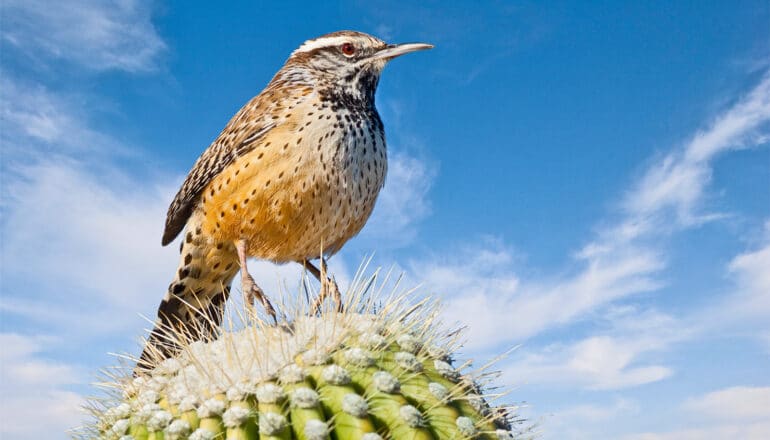
    A brown and reddish cactus wren stands on top of a green cactus with white spines.

    While birds are better able than most species to relocate in response to climate change, the environment is changing faster than they can fly, a new study finds.

    As rising global temperatures alter ecosystems worldwide, animal species usually have two choices: adapt to changing local conditions or flee to a cooler clime.

    Ecologists have long assumed that the world’s bird species were best equipped to respond to the pressures of climate change simply because they have the option of flying to higher altitudes or towards global poles.

    But a new study finds that few bird species are able to escape the realities of a warming world.

    The findings appear in the journal Nature Ecology and Evolution.

    “They can’t move fast enough or far enough to keep up with how quickly climate change is occurring,” says Jeremy Cohen, the study’s lead author. He is an associate research scientist in Yale University’s ecology and evolutionary biology department of and member of the lab of coauthor Walter Jetz.

    Jetz, a professor of ecology and evolutionary biology, is also director of the Yale Center for Biodiversity and Global Change and a chair of the EO Wilson Biodiversity Foundation.

    For the study, Cohen and Jetz analyzed data on the movements of 406 species of North American birds collected from citizen observers over two decades as well as corresponding local temperature changes. They found that many of the assumptions they’d made about how bird species are responding the climate change were correct.

    During summer, for instance, bird species on average relocated between 40 and 50 miles northward during the period covered in the data—and sometimes relocated to higher elevations. And, on average, the northbound movement helped birds avoid a temperature increase of about 1.28 degrees Celsius (2.3 degrees Fahrenheit)—or about half of the temperature increase they would have experienced if they stayed put.

    But, on average, birds still experienced a 1.35-degree Celsius (2.43 degrees Fahrenheit) increase in temperature during the summer months compared with temperatures in their original home range. During winter months, birds had only minimal success in limiting their exposure to warming, experiencing only 11% less warming than had they not moved. In winter, birds experienced on average a whopping 3.7-degree Celsius (6.66 degrees Fahrenheit) increase in temperatures over the 20 years, reducing their potential exposure only by half a degree via their movement north.

    Birds’ ability to escape higher temperatures also varied by species. Overall, more than 75% of birds managed to reach slightly cooler climes in response to warming temperatures. But some species, like the cactus wren, which is native to deserts and arid systems in North America, did not move at all, making them more susceptible to climate-triggered changes to their environmental niches.

    These so-called climatic “niche shifters” could be limited in flight capability or prevented from leaving their current home environment or competing for them in new locations by specific fine-scale habitat needs and ecological dependencies.

    Bird species capable of flying long distances were the most successful in limiting their exposure to warmer climates and retaining their historic climatic niches, the researchers found. This included the blue-winged warbler, which traveled more than 100 miles northward and experienced two fewer degrees of warming than if it had stayed put. But even these birds are dealing with temperatures that exceed those they’d known in their original home range 20 years ago.

    For species that are far less mobile than birds, such as reptiles and mammals, the options for escaping the rapid warming are even more limited.

    Climate change is expanding the gap between the climatic niche species have evolved into over thousands of years and what they experience in their home grounds, the authors say.

    “In a uniquely well-studied continental system, we find that even a highly mobile group, such as birds, is unable to relocate quickly enough to keep up with this velocity,” Jetz says

    “This raises deep concerns about the ability of all the other, less mobile species and lesser known species to persist in a warmer world. A much better understanding and management of most likely climate change victims—those most ecologically and geographically tied down—is needed to fend off an impending extinction crisis.”

    Funding for the study came, in part, from the EO Wilson Biodiversity Foundation in furtherance of the Half-Earth Project.

    Source: Yale

    The post Few bird species can escape climate change appeared first on Futurity.

  • Brain groove depth tied to better reasoning ability

    A plastic model of a human brain sitting on a table in front of a blue background.

    A new study finds that the depth of small grooves in the brain’s surface is linked to stronger network connectivity and better reasoning ability.

    Many grooves and dimples on the surface of the brain are unique to humans, but they’re often dismissed as an uninteresting consequence of packing an unusually large brain into a too-small skull.

    But neuroscientists are finding that these folds are not mere artifacts, like the puffy folds you get when forcing a sleeping bag into a stuff sack. The depths of some of the smallest of these grooves seem to be linked to increased interconnectedness in the brain and better reasoning ability.

    In a study in The Journal of Neuroscience, University of California, Berkeley researchers show that in children and adolescents, the depths of some small grooves are correlated with increased connectivity between regions of the brain—the lateral prefrontal cortex and lateral parietal cortex—involved in reasoning and other high-level cognitive functions.

    The grooves may actually bring those areas closer together in space, shortening the connections between them and speeding communications.

    The implication, the researchers say, is that variability in these small grooves, which are called tertiary sulci (pronounced sul’-sigh), may help explain individual differences in cognitive performance, and could serve as diagnostic indicators or biomarkers of reasoning ability or neurodevelopmental disorders.

    “The impetus for this study was having seen that sulcal depth correlated with reasoning across children and adolescents,” says Silvia Bunge, professor of psychology and a member of UC Berkeley’s Helen Wills Neuroscience Institute (HWNI).

    “Given our previous findings, our former postdoctoral fellow Suvi Häkkinen aimed to test if sulcal depth was correlated with reasoning performance and to test if patterns of coordinated activity within a lateral prefrontal-parietal network could explain this relation between sulcal depth and reasoning.”

    “We had explicit predictions about which tertiary sulci in the lateral prefrontal cortex would be functionally connected to tertiary sulci in the lateral parietal cortex, and that panned out,” added Kevin Weiner, UC Berkeley associate professor of psychology and of neuroscience and a member of HWNI.

    “Prefrontal and parietal cortices aside, the hypothesis is that the formation of sulci leads to shortened distances between connected brain regions, which could lead to increased neural efficiency, and then, in turn, individual differences in improved cognition with translational applications.”

    “The cortex is sort of haphazardly crunched up into the brain—that’s what I was always taught,” Bunge says. “Kevin came along and changed my mind about sulci.”

    Hills and valleys

    The brains of most animals, mammals included, have smooth surfaces. Primates have hills and valleys covering their cerebral cortex. While one group of primates, the New World monkeys called marmosets, have shallow, barely perceptible sulci, those of humans are deeply incised, with between 60% and 70% of the cortex buried in these folds.

    The cortical folding patterns in humans also change with age, establishing their final structure late in prenatal development while becoming less prominent in old age.

    “While sulci can change over development, getting deeper or shallower and developing thinner or thicker gray matter—probably in ways that depend on experience—our particular configuration of sulci is a stable individual difference: their size, shape, location, and even, for a few sulci, whether they’re present or absent,” says Bunge, who studies abstract reasoning in young people, from 6 years of age through young adulthood.

    The smallest grooves, many of which are uniquely human, are called tertiary sulci because they appear last in prenatal development and are never as deep as the major or primary sulci that are most evident on the cerebral surface.

    Scientists have speculated that the tertiary sulci emerge in parts of the human brain that have expanded the most throughout evolution and have a protracted development, and that they are likely associated with aspects of cognition—reasoning, decision-making, planning, and self-control—that develop over a protracted adolescence.

    But prior to this study, evidence was lacking for a connection between tertiary sulci and brain connectivity. The UC Berkeley study is one of few, all within the past few years, to provide such proof.

    Sulci and cognition

    Weiner and Bunge say that, as undergraduates, they were never taught how to define tertiary sulci; they often examined scans of average brains that did not match any specific individual.

    Weiner noticed this mismatch as an undergraduate.

    “At the time, all I knew was that I had some cortical squiggles that weren’t in the average brain atlases that we had in the lab. So the question I asked my mentors, Sabine Kastner and Charlie Gross, was: Do I have different structures that aren’t in our atlases or are structures missing from these atlases?” he says. “That sent me down a 15-year rabbit hole studying one particular tertiary sulcus in the visual cortex.”

    That work showed that a specific sulcus, the mid-fusiform sulcus, varied in length from as small as 3 millimeters to as long as 7 centimeters in any given person. Moreover, the longer the sulcus, the better a person was at processing and recognizing human faces.

    “About 2% of individuals have developmental prosopagnosia, which means they can’t perceive faces, and they don’t have any brain damage,” he says. “That sulcus, especially in the right hemisphere, is shorter and shallower in those folks than in what we refer to as neurotypical controls.”

    Building on that rabbit hole, Bunge and Weiner wondered whether tertiary sulci in other regions of the brain, outside the visual processing units, also correlated with cognitive ability. Upon moving to UC Berkeley in 2018, Weiner began investigating the prefrontal cortex—located in the front of the brain behind the forehead—in collaboration with Bunge, who wanted to test whether sulci in this area would be linked to reasoning.

    In a 2021 paper, the two collaborated to define all the smaller sulci in the lateral prefrontal cortex and created a computer model that identified the tertiary sulci as contributing the most variation in reasoning ability.

    “The model identified that there’s tertiary sulci in the lateral prefrontal cortex that are contributing to reasoning skills in kids,” Weiner says.

    Expanding on that work in the new study, Weiner, Bunge, and their colleagues painstakingly catalogued the tertiary sulci in the lateral parietal cortex, located under and just behind the crown of the skull, and investigated its functional connections with the sulci of the lateral prefrontal cortex. For both studies, they studied 43 participants, 20 of them female, who ranged in age from 7 to 18. While in a functional magnetic resonance imaging (fMRI) scanner, the participants were given a reasoning task. The researchers focused on the brain activity in 21 sulci they had identified in each hemisphere of the brain, and the functional connections between these sulci—including, for the first time, tertiary sulci.

    Across these individuals, greater depth for several of the sulci implicated in reasoning was associated with higher network centrality across the set of prefrontal and parietal sulci.

    Experience affects sulci

    Bunge points out that the association between depths of sulci and reasoning does not hold for all sulci, and that sulcal depth may change with experience.

    “Do we think that an individual’s capacity for reasoning is set in stone based on their cortical folding? No!,” she says. “Cognitive function depends on variability in a variety of anatomical and functional features and, importantly, we know that experience, like quality of schooling, plays a powerful role in shaping an individual’s cognitive trajectory, and that it is malleable, even in adulthood.”

    Weiner’s lab is creating a computer program to help researchers identify tertiary sulci in the human brain. Most programs only identify about 35 sulci, but when tertiary sulci are included, there are over 100, he says, including new ones that their labs have uncovered together. They argue that sulci could serve as landmarks to compare brains between individuals, since brains vary so much.

    “Dozens of brain maps have been proposed in just the last five years, but they disagree about the areas of associated regions in the cortex, and there are mismatches between areas at the group and individual level,” Weiner says.

    “Examining network architecture based on individual sulcal morphology circumvents these disagreements and mismatches, with the opportunity to glean network-level insight from the local sulcal anatomy that is specific to a given individual.”

    Support for this work came from the National Institutes of Health through grants from the Eunice Kennedy Shriver National Institute of Child Health and Human Development and the National Institute of Mental Health, and the National Science Foundation.

    Source: UC Berkeley

    The post Brain groove depth tied to better reasoning ability appeared first on Futurity.

  • Tracking the Sediment Carried by the Muddy Mississippi

    A bird’s-eye view of the Mississippi River delta. The main river runs left to right across the photo and wispy clouds are visible in the foreground.

    Mississippi River ships and barges carry over 500 million tons of cargo through the Southwest Pass shipping channel at the river’s end to reach major ports that handle 18% of U.S. waterborne commerce. For almost 100 years, levees and other human-made flood control structures have lined the banks of the river, obstructing its land-building silt, sand and clay from naturally rebuilding land along coastal Louisiana.

    That sediment is essential to rebuilding—or at this point, maintaining—the fragile coastline that has been receding for decades. Without it, the small towns that dot the lower part of the Louisiana Gulf Coast are left exposed, with no protection against storm surges and hurricane-strength winds. But to reverse coastal erosion, scientists found that they first had to understand where sediment that could be used to rebuild settles instead.

    Most of the year, less than 10% of the river’s sediment reaches the critical Bird’s Foot Delta, according to scientists from the Mississippi River Delta Transition Initiative, known as MissDelta. The bird’s foot—at the southernmost reach of the river system that juts into the Gulf of Mexico—plays a vital role in coastal protection, navigation, fisheries and energy infrastructure.

    In 2023, MissDelta launched a $22 million, five-year research project spearheaded by Tulane University and Louisiana State University, and funded by the National Academies of Sciences, Engineering and Medicine. The study aims to evaluate the Delta and Southwest Pass, the critical navigation channel, with hopes of finding management approaches that will benefit both the delicate ecosystem and the people who live and work in the delta region, including fisherpeople, charter-boat operators, offshore workers, shipyard builders, mechanics and petrochemical-facility operators.

    Seven people sand on a small boat next to a dock. They are surrounding a sediment sampler, which looks similar to a miniature rocket.
    A team of researchers from Tulane University and the University of Louisiana at Lafayette pose for a portrait on a dock in Venice, La., with the PS-200 isokinetic sediment sampler used to collect water samples from the Mississippi River on 23 April 2025. Credit: Stacey Plaisance, Tulane University

    During the first year-and-a-half of the study, researchers measured discharge by plunging a 200-pound sampler into the river at various depths. By tracking sediment from the sampler, the team can measure how much settles in the wetlands upriver versus how much exits into the deepwater Gulf, said Claire Kemick, a Tulane graduate student working to collect the samples.

    The study’s early findings, announced at Louisiana’s State of the Coast conference, show that the Mississippi River loses substantial amounts of water and sediment above what’s called the Head of Passes, at the mouth of the river, where the Mississippi forms its distinct bird’s foot by branching into three directions: the Southwest Pass shipping channel (west), Pass A Loutre (east) and South Pass (center).

    Bird’s Foot Delta is headed toward further degradation, after losing ground for decades.

    That means the Bird’s Foot Delta is headed toward further degradation, after losing ground for decades, said Mead Allison, co-lead of MissDelta and a professor in Tulane’s Department of River-Coastal Science and Engineering.

    Above the Head of Passes, substantial amounts of sediment carried by the Mississippi River are lost through both natural and man-made channels, such as the rapidly expanding Neptune Pass near Buras, Louisiana, in lower Plaquemines Parish. But most is lost well before then.

    Using data on sediment movement, the team can calibrate models to predict what will happen to the delta by 2100 under different scenarios, with varied sea-level rise, storm frequency and river-flow fluctuations. Once the researchers develop the models, they will use them to test various interventions that could save the delta, such as closing river exits and changing water-flow patterns.

    In the fall, the MissDelta team will return to lower Plaquemines Parish to study the saltwater wedge that creeps up the river during low flow periods. For three years in a row, the wedge of heavy salt water has crept up the river underneath the fresh water, imperiling drinking water in the greater New Orleans area.

    The goal is to find management approaches that can help build up this region, which Allison has called one of the most threatened places in the nation, if not on Earth.

    But they cannot forge management solutions without an understanding of how the muddy Mississippi carries its load of sandy sediment in the lower delta. “Right now, we don’t know very much about where the sediment is in the Lower Mississippi River,” Kemick said. Further research will help determine where the coarse sand is settling in the riverbed.

    “Sand is white gold for Louisiana. We need to keep it.”

    Sediment loss is especially high during low or average river flow, when the water is traveling slowly enough to allow the heavy sand particles to sink to the bottom. When the river floods, the faster-moving river brings sand from throughout the drainage basin to Louisiana. But it doesn’t necessarily help to build up the Bird’s Foot area. Instead, it falls out in the channel, creating a need for more dredging to maintain the ship route.

    The Mississippi River’s sediment is an important resource for coastal restoration, Allison said. “Sand is white gold for Louisiana. We need to keep it.”

    The Louisiana Coastal Master Plan was built upon this principle, with an ambitious plan for a sediment diversion, the Mid-Barataria Sediment Diversion, that would be one of the largest environmental infrastructure projects in the history of the U.S.

    But the U.S. Army Corps of Engineers has suspended the permit to build the keystone project.

    On Wednesday, more than 50 Louisiana business and civic leaders sent a letter to Gov. Jeff Landry urging him to resume construction of the Mid-Barataria Sediment Diversion at the size and scale that it was designed and permitted for.

    “Delaying or downsizing the Mid-Barataria Sediment Diversion threatens not just our coast, but our economy, our safety and our credibility as a state.”

    “These business and civic leaders are part of the backbone of Louisiana—people who live, work, and invest in this region every day,” said Simone Maloz, campaign director for Restore the Mississippi River Delta. “Delaying or downsizing the Mid-Barataria Sediment Diversion threatens not just our coast, but our economy, our safety and our credibility as a state.”

    Conversations about the Mid-Barataria Sediment Diversion were absent from this year’s State of the Coast conference, an interdisciplinary forum hosted by the Coalition to Restore Coastal Louisiana.

    “In some ways, I feel like Mid-Barataria is kind of haunting this conference,” said Alisha Renfro, a coastal scientist with the National Wildlife Federation. She is hopeful that Louisiana can find a pathway to resume the project, after investing $500 million into planning.

    The state is also in danger of losing billions in federal funding if its leaders don’t commit to finishing the construction.

    It may be time to look for alternative coastal restoration projects, some scientists say. For Allison, that means not only determining how the Mississippi River sediment moves now but also where dredged sand could best restore coastal wetlands like the Barataria Basin.

    Currently, dredge spoil used for coastal restoration remains relatively close to where it came from in the river. In the Barataria Basin, one project to restore approximately 302 acres of brackish marsh known as Bayou Grande Cheniere required nearly eight miles of pipes to move the sediment.

    A map of the Bird’s Foot Delta including, the Mudflow Gully Zone, and the Mudflow Lobe Zone, and the Prodelta Zoneshows that the bathymetry depth varies around different distributaries.
    A map of the Bird’s Foot Delta showing underwater depth based on the three distributaries. Credit: USGS

    Other solutions might involve closing gaps where sediment leaks out before reaching the Bird’s Foot Delta. The Army Corps is essentially testing this theory now, Allison said, with its plan to reduce the flow at Neptune Pass, a nearby branch in the river that is creating new land in Quarantine Bay.

    The plan could boost land-building in the Barataria Basin, Allison said. While the Army Corps proposes using rocks to limit the size of the channel’s entrance and minimize the risk of navigational hazards, the construction at the outflow could reinforce the crevasse’s land-building power, he said.

    In addition to building sediment retention structures, the Army Corps could pump sand out of the river and place it directly at the outflow of the channel, allowing the water to redistribute it into a more natural wetland building pattern.

    “It’s really encouraging that the Corps is thinking about these forward-looking strategies to better use dredged material,” Allison said.

    This story is a product of the Mississippi River Basin Ag & Water Desk, an independent reporting network based at the University of Missouri in partnership with Report for America, with major funding from the Walton Family Foundation.

    —Delaney Dryfoos (@delaneydryfoos.bsky.social), The Lens

  • Algunos árboles tropicales se benefician de los rayos

    Un gran árbol con flores rosadas se alza por encima de un bosque de otros árboles verdes.

    This is an authorized translation of an Eos article. Esta es una traducción al español autorizada de un artículo de Eos.

    De vez en cuando, algunos árboles parecen necesitar una sacudida. Cuando es alcanzado por un rayo, el frondoso Dipteryx oleifera sufre daños mínimos, mientras que los árboles y enredaderas parásitas de las inmediaciones suelen marchitarse o morir por completo. Los investigadores estiman que la eliminación de la vegetación competidora multiplica casi por quince la producción de semillas de D. oleifera a lo largo de su vida.

    Un bosque bien equipado

    “Este es el único lugar de la Tierra en el que disponemos de datos precisos de seguimiento de rayos para saber si [un rayo ha caído] en una zona del bosque”.

    Panamá suele ser conocida por su canal homónimo. Sin embargo, la Isla de Barro Colorado, en el centro de Panamá, también alberga lo que los investigadores que trabajan en el área llaman “una de las zonas de bosque tropical mejor estudiadas de la Tierra”. Esto se debe a que cámaras y aparatos para medir campos eléctricos vigilan constantemente el bosque desde lo alto de una serie de torres de unos 40 metros de altura. Estos instrumentos pueden revelar, entre otros datos, la ubicación exacta de la caída de rayos. “Este es el único lugar de la Tierra en el que disponemos de datos precisos de seguimiento de rayos para saber si [un rayo ha caído] en una zona del bosque”, explica Evan Gora, ecólogo del Instituto Cary de Estudios de Ecosistemas y del Instituto Smithsoniano de Investigaciones Tropicales.

    Según Gabriel Arellano, ecólogo forestal de la Universidad de Michigan en Ann Arbor que no participó en la investigación, este tipo de infraestructura es fundamental para localizar los árboles que han sido alcanzados por un rayo. “Es muy difícil hacer un seguimiento de los rayos y encontrar los árboles concretos que se han visto afectados”.

    Esto se debe a que el impacto de un rayo en un árbol tropical rara vez provoca un incendio, explica Gora. Lo más habitual es que los árboles tropicales alcanzados por un rayo parezcan prácticamente intactos, pero mueren lentamente a lo largo de varios meses.

    Siguiendo los destellos

    Para comprender mejor cómo afectan los rayos a los grandes árboles tropicales, Gora y sus colegas examinaron 94 rayos que cayeron sobre 93 árboles únicos en la isla de Barro Colorado entre 2014 y 2019. En 2021, el equipo viajó a la isla para recopilar imágenes terrestres y aéreas de cada árbol impactado directamente y sus alrededores.

    Gora y sus colegas registraron seis parámetros sobre el estado de cada árbol afectado directamente y del grupo de enredaderas leñosas parásitas conocidas como lianas: pérdida de la copa, daños en el tronco y porcentaje de la copa infestada de lianas. Las lianas colonizan las copas de muchos árboles tropicales, usándolas para darse estructura y compitiendo con los árboles por la luz. Piensa en alguien que se sienta a su lado y le arranca la mitad de cada bocado de comida que tomas, dice Gora. “Eso es efectivamente lo que hacen estas lianas”.

    El equipo también examinó los árboles que rodeaban a cada uno de los que habían sido alcanzados directamente. La corriente eléctrica de un rayo puede viajar por el aire y atravesar también los árboles cercanos, explica Gora. Cuando las ramas de un árbol alcanzado por u nrayo están cerca de las de sus vecinos, “los extremos de sus ramas y las de sus vecinos mueren”, explica Gora. “Verás docenas de esos lugares”.

    Creciendo prosperamente después de un rayo

    Los investigadores descubrieron que en promedio una cuarta parte de los árboles alcanzados directamente por un rayo morían. Pero cuando el equipo dividió su muestra por especies de árboles, el D. oleifera (más conocido como almendro o haba tonka) destacó por su asombrosa capacidad para sobrevivir a los rayos. Los nueve árboles D. oleifera de la muestra del equipo sobrevivieron sistemáticamente a los rayos, mientras que a sus lianas y vecinos inmediatos no les fue tan bien. “Hubo daños considerables en la zona, pero no en el árbol directamente afectado”, explica Gora. “Éste nunca murió”.

    (Otras diez especies del grupo de árboles de los investigadores tampoco mostraron mortalidad tras ser alcanzadas por un rayo, pero todas esas muestras eran demasiado pequeñas, entre uno o dos individuos, para extraer conclusiones sólidas).

    Dos imágenes muestran el mismo árbol, antes (izquierda) y después (derecha) del impacto de un rayo. En la imagen de la derecha, el árbol no está cubierto de enredaderas leñosas y algunos de los árboles que lo rodean han muerto.
    Se muestra un árbol de <em>D. oleífera</em> en Panamá justo después de ser alcanzado por un rayo en 2019 (izquierda) y 2 años después (derecha). El árbol sobrevivió al impacto, pero sus enredaderas parásitas y algunos de sus vecinos no. Crédito: Evan Gora

    Gora y sus colaboradores calcularon que los grandes árboles de D. oleifera son alcanzados por un rayo un promedio de cinco veces a lo largo de sus aproximadamente 300 años de vida. El equipo infirió que la capacidad de esta especie para sobrevivir a esos eventos, mientras que las lianas y los árboles vecinos a menudo morían, debería traducirse en una reducción general de la competencia por los nutrientes y la luz solar. Al usar modelos de crecimiento y capacidad reproductiva de los árboles, los investigadores calcularon que D. oleifera obtenía beneficios sustanciales de ser alcanzada por un rayo, sobre todo en lo que respecta a la fecundidad, es decir, el número de semillas producidas a lo largo de la vida de un árbol. “La capacidad de sobrevivir a los rayos multiplica por catorce su fecundidad», afirma Gora.

    D. oleifera esté evolucionando para convertirse en un mejor pararrayos.

    Los investigadores demostraron además que D. oleifera tendía a ser más alto y ancho en su copa que muchas otras especies de árboles tropicales de la Isla de Barro Colorado. Trabajos anteriores de Gora y sus colegas han demostrado que los árboles más altos corren especial riesgo de ser alcanzados por un rayo. Por tanto, es posible pensar que D. oleifera esté evolucionando para convertirse en un mejor pararrayos, afirma Gora. “Quizá los rayos estén moldeando no sólo la dinámica de nuestros bosques, sino también su evolución”.

    Estos resultados fueron publicados en New Phytologist.

    Gora y sus colaboradores partieron de la hipótesis de que la fisiología de D. oleifera debe de otorgar cierta protección contra la enorme cantidad de corriente impartida por un rayo. Trabajos anteriores de Gora y otros investigadores han sugerido que el D. oleifera es más conductor que el promedio; niveles más altos de conductividad significan menos resistencia y, por tanto, menos calentamiento interno. “Creemos que el grado de conductividad de un árbol influye mucho en si muere o no”, afirma Gora.

    Seguir descubriendo otras especies de árboles resistentes a los rayos será importante para comprender cómo evolucionan los bosques a lo largo del tiempo. Es ahí donde más datos serán útiles, dijo Arellano. “No me sorprendería que encontráramos muchas otras especies”.

    —Katherine Kornei (@KatherineKornei), Escritora de ciencia

    This translation by Mónica Alejandra Gómez Correa was made possible by a partnership with Planeteando y GeoLatinas. Esta traducción fue posible gracias a una asociación con Planeteando and GeoLatinas.

    Text © 2025. The authors. CC BY-NC-ND 3.0
    Except where otherwise noted, images are subject to copyright. Any reuse without express permission from the copyright owner is prohibited.
  • Nottingham Trent University and the University of Hull

    A part of the campus at Nottingham Trent University.

    Later this year I’ll leave the University of Hull to take up the role of Vice-Chancellor and President at Nottingham Trent University.

    Image of a landslide partially covered with a transparent sand-colored overlay and the words “The Landslide Blog,” centered, in white

    Nottingham Trent University has about 40,000 students and staff spanning five university sites. It is the fifth largest university in terms of enrolled students in the UK. In recent years it has enjoyed remarkable success, led by its current Vice-Chancellor and President, Professor Edward Peck. For example, it has been named University of the Year repeatedly over the last decade (e.g. THE Awards 2017, The Guardian Awards 2019, The Times and Sunday Times 2018 and 2023, Whatuni Student Choice Awards 2023). It has an extraordinary track record in terms of widening participation and it is deeply rooted in its local communities.

    A part of the campus at Nottingham Trent University.
    A part of the campus at Nottingham Trent University. Image by NTU Credit: Nottingham Trent University

    Thus, it is a real honour to have been invited to become NTU’s next Vice-Chancellor and President, a role that I will take up in December 2025. I’m very excited to have the opportunity to work with its staff, students and alumni, as well as its many partners across the East Midlands and beyond. To be able to lead such an institution will be an extraordinary priviledge.

    Of course, this means that I must step down from my role as Vice-Chancellor of the University of Hull in December. I’ll do so with real sadness – I’ve loved my time at Hull. It’s a wonderful University with exceptionally dedicated staff, inspiring students and deeply engaged alumni. Since I joined the University we have done a considerable amount of work to respond to the major challenges that the sector is facing. The ways in which the community has engaged with this has been amazing, and the trajectory of the University is now steeply upwards. I’m sure that the University has a bright future and that it will thrive in my absence.

    Of course, I’ll continue to be Vice-Chancellor of the University of Hull for the next six months, and I’ll remain committed to the mission of the institution through this time. There will be many more opportunities to describe the great things that are happening at Hull.

    Over the remainder of the year I’ll be extraordinarily fortunate to be able to engage with two amazing academic communities. I’ll do so with a sense of great excitement.

    Text © 2023. The authors. CC BY-NC-ND 3.0
    Except where otherwise noted, images are subject to copyright. Any reuse without express permission from the copyright owner is prohibited.
  • Ocean damage unspeakably awful, Attenborough tells prince

    Sir David Attenborough told Prince William he hopes the UN oceans conference will bring new protections.